
Central Florida listings use lanai, Florida room, and sunroom almost interchangeably, and homeowners planning a project inherit the confusion. They are not the same structure. They differ in what the walls are made of, whether the space is heated and cooled, whether it counts as living area, what the building code asks of it, and — by a wide margin — what it costs. Here is how to tell them apart before you price anything.
The Three Structures, Plainly
Lanai
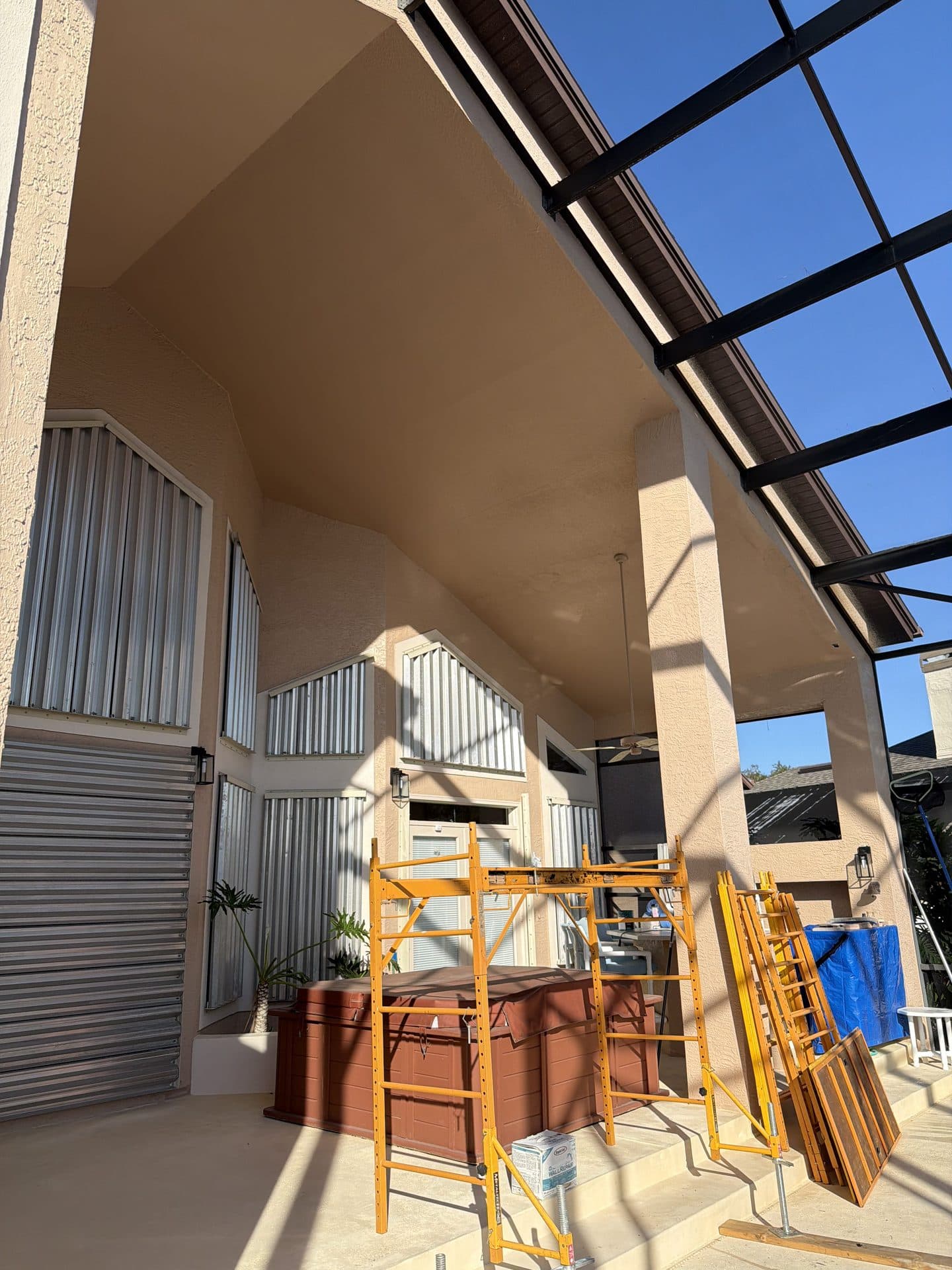
“Lanai” is Florida's word for a covered outdoor living space attached to the house — a roofed patio or porch, almost always screened. The walls are insect screen, the space is open to outdoor air, and nothing about it is heated or cooled. When it wraps the pool and deck as well, it becomes a pool enclosure, or pool cage; our pool enclosure vs. screened lanai guide covers that specific fork.
Florida Room
A Florida room is what a lanai typically becomes when the screen walls are replaced with real walls and windows — often glass sliders or a run of windows on a knee wall — usually on the original slab and under the original roof. It is enclosed against rain and bugs, and it may or may not be conditioned. That last point is the whole question: an unconditioned Florida room is a three-season room that still gets hot in August, while a conditioned one, tied into the house and its air conditioning, is effectively a small addition.
Sunroom
In everyday use a sunroom is the glass-heavy version of the same idea — more window than wall, sometimes with a glazed roof. In the building code, though, “sunroom” is the umbrella term for all of these structures, and the code sorts them into categories that decide what the permit will require. That is the part worth understanding.
What the Florida Building Code Actually Calls Them
The Florida Building Code — Residential (Section R301.2.1.1.1) requires sunrooms to comply with the AAMA/NSA 2100 sunroom standard and defines five categories. The category is declared on the permit application, and it sets the performance the windows, doors, and envelope have to meet:
- Category I — thermally isolated from the house; walls open or enclosed with insect screening. Nonhabitable, unconditioned. This is a screened lanai or pool cage.
- Category II — thermally isolated, enclosed walls with glass or plastic glazing. Still nonhabitable and unconditioned. A basic enclosed Florida room.
- Category III — like Category II, with tighter air-infiltration and water-penetration requirements on the glazing.
- Category IV — conditioned, but nonhabitable, with its own separate temperature control, and higher fenestration performance. A Florida room on a mini-split, separated from the house by a door.
- Category V — enclosed, heated and cooled, and open to the main structure. Habitable and conditioned, with the strictest window and door requirements. This is the version that is really an addition.
Why it matters: the higher the category, the more the project resembles conventional construction. Category V space has to meet the energy code and the same envelope standards as the rest of the house, which is why a “just enclose the lanai” conversation can turn into an addition conversation once the homeowner says they want it air-conditioned and open to the kitchen.
What Each Costs in Orlando
Because these are different structures, they price in different brackets. The figures below are the same ranges we publish in our pool enclosure cost guide and home addition cost guide:
- Screened lanai (screen walls on an existing slab or patio): $6,000–$15,000
- Lanai with a solid roof structure: $15,000–$35,000
- Standard pool enclosure: $8,000–$20,000, with premium or oversized cages at $20,000–$40,000+
- Conditioned Florida room built as new space: priced per square foot like an addition — roughly $200–$350/sq ft for a bump-out and $250–$425/sq ft for a ground-floor room addition, turn-key including permitting
Enclosing an existing lanai sits between those brackets, and the honest answer is that it has to be measured. The existing slab and roof take real work off the list, but the items that make conditioned space expensive do not go away: structural review of what is already there, energy-code-rated windows and doors, insulation, and a way to heat and cool it. The addition guide's HVAC line applies here too — a mini-split for the new space typically runs $3,500–$6,500, or upsizing the existing system $4,500–$9,000 — and if the room becomes net new conditioned square footage, impact fees in the $2,000–$8,000 range can apply depending on the jurisdiction. Our cost calculator will give you the addition-tier ballpark in seconds.
Permits: All Three Need One
Screen enclosures, enclosed rooms, and additions all require permits in Orange, Osceola, and Seminole counties — enclosures are on the list explicitly, and enclosing walls, adding electrical, or adding conditioned space each trigger one on their own. Two things are specific to this project type. First, the sunroom category is part of the application, so decide early whether you want unconditioned, conditioned-but-separate, or fully open to the house; changing your mind mid-permit means re-engineering. Second, if you live in a community with an architectural review board, that approval is a separate step that generally sits in front of the permit, and it is not satisfied by the permit itself. Our Orlando-area permit guide lists which office handles each city, and the permit-process walkthrough covers what happens after you file.
Which One Do You Actually Want?
- You have a pool, or you mainly want to sit outside without bugs. A screened lanai or pool enclosure. It is the least expensive structure, the fastest to build, and in Orlando it is what buyers expect on a pool home.
- You want a rain-proof, bug-proof room you will use most of the year, and you are fine with it being warm in summer. An unconditioned Florida room (Category II or III). Glass or vinyl panels over the existing lanai, no HVAC, no energy-code envelope.
- You want a room that stays comfortable in August but do not need it counted as part of the house. A Category IV room on its own mini-split, separated from the house by a door. Comfortable, and simpler to permit than full conditioned space.
- You want real living area — a family room, an office, a dining room that flows from the kitchen. That is Category V, and you should plan and budget it as an addition. It is the only version that adds conditioned square footage, and it is the one where finishes, HVAC, and the envelope have to be done properly to be worth the money.
The most common mistake we see is the third and fourth options being priced as if they were the second. If a bid for a conditioned Florida room looks like a screened-lanai bid with windows added, ask what category it was written to.
Not Sure Which Category Your Idea Falls In?
Call (407) 634-4099 for a free phone consultation. We build screened enclosures and conditioned additions across Orlando and Central Florida, and we will tell you plainly which one your plan actually is.
Frequently Asked Questions
Why are pools in Florida screened?
Insects first — no-see-ums, mosquitoes, and love bugs make an open pool deck hard to enjoy for much of the year. A screen enclosure also keeps leaves and debris out of the water, which cuts skimming and chemical use, and it filters some UV. In Orlando a screened enclosure is close to standard equipment on pool homes, and a cage can also serve as part of the pool barrier the residential code requires.
Does a Florida room count as living space?
Only when it is built as conditioned, habitable space — a Category V sunroom under the Florida Building Code, heated and cooled and open to the main house. That is the version that adds conditioned square footage. A screened lanai or an unconditioned enclosed room does not count the same way, which is exactly why the cost and the permit path are so different.
Can I enclose my existing screened lanai into a Florida room?
Usually, yes, and it is one of the most common outdoor-living projects in Central Florida. It needs a permit, the sunroom category has to be declared on the application, and the windows or sliders must meet the performance requirements for that category. If the goal is a conditioned room, plan for the energy code, an HVAC solution, and structural review of the existing slab and roof — the existing structure takes work off the list, but it does not remove those items.
How much does a Florida room addition cost in Orlando?
It depends entirely on which structure you are actually building. A screened lanai generally runs $6,000–$15,000, and a lanai with a solid roof structure $15,000–$35,000. A conditioned Florida room built as new space is priced like a room addition — roughly $200–$350 per square foot for a bump-out and $250–$425 per square foot for a ground-floor room addition, turn-key including permitting. Enclosing an existing lanai lands somewhere in between, and we price it after measuring.